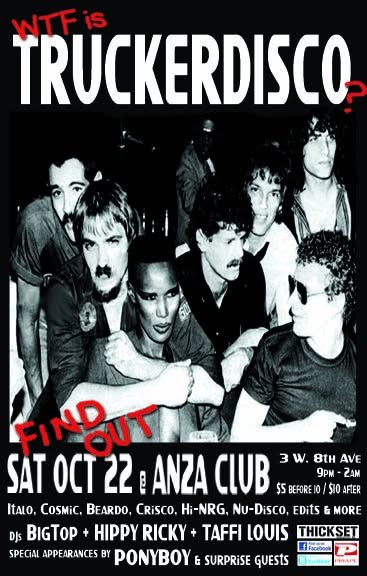
On October 22, 2011, Truckerdisco was an experiment that kicked off a four-year run of events and defied conventional marketing wisdom and challenged the notion that success means beating the biggest at their own game. The premise was deceptively simple: disco had a lot more going for it than its reputation suggested.
Since the Disco Demolition Night stunt in 1979, “disco” had become a dirty word in North America. Elsewhere, though, it kept mutating alongside synthpop and ’80s new wave, eventually giving us Italo disco and records like Mr. Flagio’s “Take A Chance” and Kano’s “I’m Ready”.
Alongside that came the stranger, more experimental sounds of Black Devil, a.k.a. Bernard Fevre (and later known as "Black Devil Disco Club" after too many people read the name of his "Disco Club" EP as the artist name), whose tape-loop experiments ran parallel to the unorthodox mixing techniques of Italian DJ Daniele Baldelli. Baldelli famously played some records intended for 45 rpm at 33 rpm, creating a slowed-down sound with extra weight and thickness in the percussion — an effect some TikTok videos are taking full advantage of today. Fevre and Baldelli became closely associated with cosmic disco, a darker, psychedelic sound more in line with the Doctor Who theme than anything from Saturday Night Fever. These were the kinds of artists whose records underground techno DJs were eagerly hunting down throughout the 2000s.
I was already a big fan of electronic disco pioneer Giorgio Moroder. His work with Donna Summer remains some of the most timeless pop music ever made. In 1977, the same year Star Wars arrived, Moroder and Summer unleashed the Star Wars of popular dance music: “I Feel Love.” Nearly 50 years later, it still sounds futuristic. Younger people have asked me what the track is when I play it out, then refused to believe it isn’t a new release.
Moroder’s work with <a href=“ https://youtu.be/9_PGv4DGMvg?si=kBTi_TPr8D-mpAnE”>Sparks ha couple of years later produced one of my favourite albums of all time, <a href=“ https://music.apple.com/ca/album/no-1-in-heaven/279544213”>No. 1 in Heaven, a concept album beginning with the plight of a single sperm, as if it were competing in the job market, and ending in the afterlife, where ecstasy and boredom are indistinguishable. There’s no rule stating that the Mael brothers’ witty, scathing lyrics would be too cerebral for Moroder’s electronic spectacle, trademark four-to-the-floor beats and the pounding kick of drummer Keith Forsey, who would go on to produce Billy Idol and work with Simple Minds at their peaks.
Much of my own DJing had been in bars and pubs, playing for an older gay clientele nostalgic for underground disco they thought they’d never hear again on a big sound system. Talking to regulars every weekend introduced me to music I might never have discovered otherwise. Many were also among the people most familiar with the Italo disco that had made it to North America.
I was fortunate enough to have people show up with bins of late-’70s and early-’80s Italo and Hi-NRG 12-inch singles, giving away their collections in the hope that someone would play those records out again.
Meanwhile, a younger, mostly straight hipster crowd attending weeknight club events was already embracing many of the same tracks. They knew the Skatt Bros’ “Walk the Night” [if you saw the movie M3GAN, it features prominently when the robot doll uses blade off a paper cutter as a machete], and never batted an eye at the song’s unmistakable S&M homoeroticism. Electroclash had already been central to my sets for a decade, but I never passed up an opportunity to slip in Tapps’ “My Forbidden Lover” or Misty Lane’s “Energy”.
Truckerdisco was predominantly queer, but it wasn’t built around exclusivity or any particular idea of what a queer night out was supposed to look like. At the time, queer event promotion often leaned heavily on hypersexualized imagery: steamy models giving their best come-hither looks, even when the event was little more than a pub social.
Truckerdisco was never going to be that. Still, people approached me about collaborating on events only to insist that the promotional imagery feature someone “you know, at least hot,” as though there were a universal consensus on what that meant, aside from just being more predictable visual clutter to navigate through online or out in public. My posters made it pretty clear I wasn’t interested in conventionally attractive models posed to make an event look like an ad for a 1-900 chatline. For some people, apparently, that was the only way to sell a night out.
I wanted to invite DJs for their music, not push them to act like influencers or turn every set up to eleven. The crowd was mixed, welcoming and enthusiastic about the records. That atmosphere became as important to me as the music itself. Another inspiration was a roughly 20-second YouTube clip of James Murphy of LCD Soundsystem at Horse Meat Disco, turning to mush over Moon Ray’s Italo classic “Comanchero.” Murphy’s own music and label had influenced me for years, and he represented a generation of artists who helped make it possible for younger audiences to embrace disco as something more than a punchline.
In the clip, Murphy is at the London Eagle alongside Severino Panzetta, bearing an uncanny resemblance to my friend Isaac, a.k.a. DJ Pandemonium
Along the way, I had the opportunity to work with talented local DJs and producers,including Woodhead, who inadvertently came up with the name "Truckerdisco", and visiting artists and friends from Seattle and beyond, like La Royale & Yesco of Mexico City’s Electrique Music label, who just happened to have the most appropriate slogan, "EL DISCO ES KULTURA".
I also had immeasurable help from the people who set up and cleaned up, worked the door and coat check, distributed flyers and posters, and dealt with lineups. Much of that work went unrecognized, but Truckerdisco couldn’t have happened without it.
Just as important were the people who showed up and challenged conventional wisdom about “knowing your audience” before putting on an event. The more diverse, the better. Our crowd ranged from people who were barely 19 to those who remembered disco in the ’70s.
When asked who the night was for, I’d usually point to the tagline: “For Guys, grrls, hipsters, homos, str8 friends, folks of all bearish persuasions, killer mustaches, moustache riders, muff drivers, disco dancers, sweet romancers — maybe even you, too!”
People didn’t segregate themselves into cliques. They mingled. Those who wanted to sit, chat or simply listen could do so; those who wanted to dance could dance with whoever they pleased. There were remarkably few security issues, and some venues even told me they needed less security for Truckerdisco than they typically did for other events.
I’ll follow up with some poster graphics, DJ mixes and more recollections of the venues we had the pleasure of working with over the next four years. I also need to build a comments section for this blog. I’d love to hear from anyone with a funny story to share — or anyone who still has a Truckerdisco T-shirt tucked away somewhere. You can still drop me a line through the Contact tab up top.
For now, here’s the first of six Truckerdisco DJ mixes I posted online to promote the night and get the idea across.